Export Payment Methods in India (2026): LC vs TT vs DP — Which Is Safest?
The biggest risk in export business is not finding buyers — it is shipping goods and not getting paid. Every Indian exporter faces one question before the first order: which export payment method should I use? The answer decides whether you sleep peacefully or chase money across borders. This guide explains LC vs TT vs DP vs DA in plain language, with costs, risks, and exactly when to use each.
The 4 Payment Methods Every Exporter Must Know
| Method | How It Works | Security for Seller | Typical Use |
|---|---|---|---|
| TT Advance (Telegraphic Transfer) | Buyer wires money before shipment | Highest — you get paid first | New buyers, small orders, first-time deals |
| LC (Letter of Credit) | Buyer’s bank guarantees payment against documents | High — bank-guaranteed | Large orders, new but credible buyers, importers’ requirements |
| DP (Documents against Payment) | Buyer pays at sight to get shipping documents | Medium — payment before documents released | Established buyers, repeat orders |
| DA (Documents against Acceptance) | Buyer accepts a bill and pays later (30–90 days) | Low — credit given to buyer | Trusted long-term buyers only |
| Open Account | Ship first, invoice, buyer pays later | Lowest — avoid unless insured | Very trusted partners, credit-insured deals |
LC vs TT: The Direct Comparison
| Factor | Letter of Credit (LC) | Telegraphic Transfer (TT) |
|---|---|---|
| Payment guarantee | Buyer’s bank guarantees payment | No bank guarantee — only buyer’s promise |
| Risk to exporter | Low (bank risk instead of buyer risk) | Medium (depends on advance %) |
| Cost | High — LC opening + negotiation + discrepancy charges | Low — just wire charges |
| Time to payment | 5–15 days after documents are presented | 2–5 days after wiring |
| Paperwork | Heavy — documents must match LC terms exactly | Minimal |
| Best for | Large orders, new buyers, high-value goods | Small orders, repeat buyers, partial advance |
The short version: LC is safer but costlier and stricter; TT is faster and cheaper but only as safe as the advance percentage. Most exporters use 30–50% TT advance + balance by LC or DP — a blend that covers your cost and keeps the buyer honest.
How a Letter of Credit Actually Works
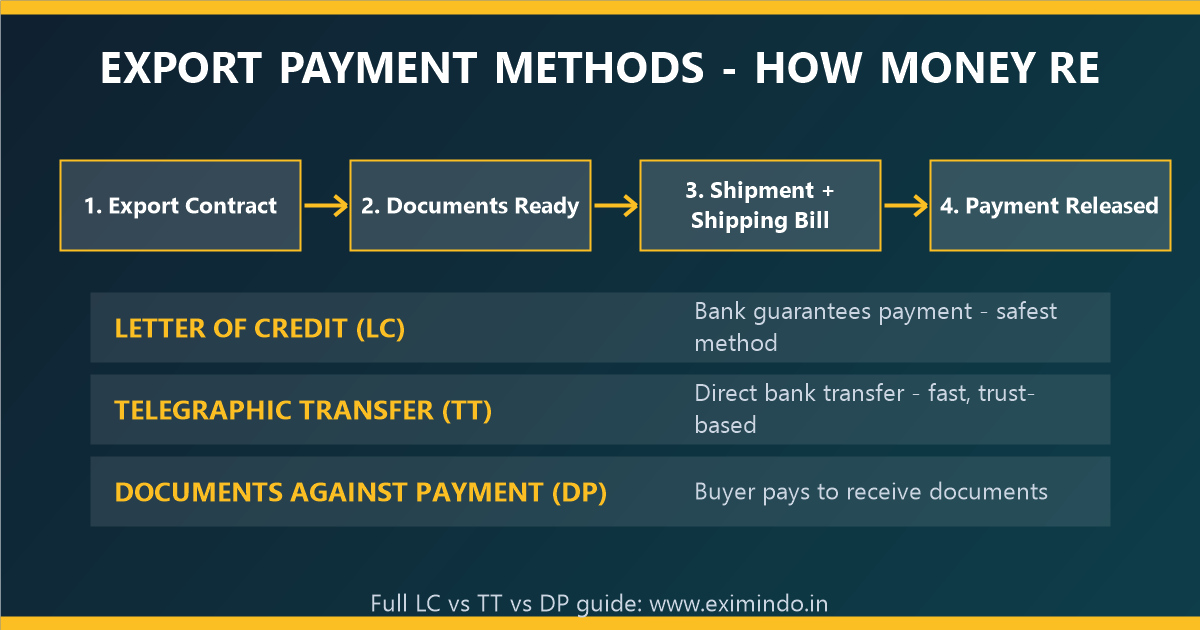
- You and the buyer agree on terms; buyer applies to their bank for an LC in your favour
- Your bank receives and advises the LC — check every field (amount, dates, documents, shipping terms)
- You ship the goods exactly as the LC says
- You present the documents (invoice, packing list, bill of lading, etc.) to your bank
- Your bank checks documents against the LC; if they match, the buyer’s bank pays
One discrepancy in a document — a spelling difference, a late date — and the LC payment can be delayed by weeks. That is why LC-based exporters train seriously on documentation.
When to Use Each Method
- New buyer, first order: insist on 30–50% TT advance; balance on DP or LC
- Large order (₹10 lakh+): LC — bank guarantees protect both sides
- Repeat, trusted buyer: DP or 30% advance + balance on TT after shipment
- Small orders (< ₹2 lakh): full TT advance — transaction costs make LC uneconomical
- Only use DA / open account when you have history and preferably trade credit insurance
Payment Risks to Protect Against
- âš ï¸ Buyer disappears after goods are shipped (no advance taken)
- âš ï¸ Fake purchase orders and “advance fee” scams targeting new exporters
- âš ï¸ LC discrepancies used as an excuse not to pay
- âš ï¸ Currency fluctuation eating your margin — consider quoting in USD with a buffer
- âš ï¸ Unverified buyers on buyer directories — verify via DGFT denied-entity lists and buyer background checks
Learn Payment Terms & Negotiation Practically
Payment terms are negotiated on every single order, and the skill is learned by practice. Our export import course covers LC drafting, TT advances, DP/DA, and real invoice negotiation in 69 practical lessons (Hindi + English, online + offline). It’s the same training that has built our export import training program in Indore and helped 1.5 lakh+ students. See why exporters call it the best export import course in India, and check realistic margins in our export business profit guide.
Confused about which payment method a specific buyer is asking for? Ask us on WhatsApp (+91 89898 65646) — free consultation. Follow @eximindo on Instagram and Eximindo on LinkedIn for export trade tips.
Leave a Reply