Tag: export business

  • Export Payment Methods in India (2026): LC vs TT vs DP – Which Is Safest?

    Export Payment Methods in India (2026): LC vs TT vs DP – Which Is Safest?

    Export Payment Methods in India (2026): LC vs TT vs DP — Which Is Safest?

    The biggest risk in export business is not finding buyers — it is shipping goods and not getting paid. Every Indian exporter faces one question before the first order: which export payment method should I use? The answer decides whether you sleep peacefully or chase money across borders. This guide explains LC vs TT vs DP vs DA in plain language, with costs, risks, and exactly when to use each.

    Letter of credit vs telegraphic transfer - export payment methods for Indian exporters | Eximindo

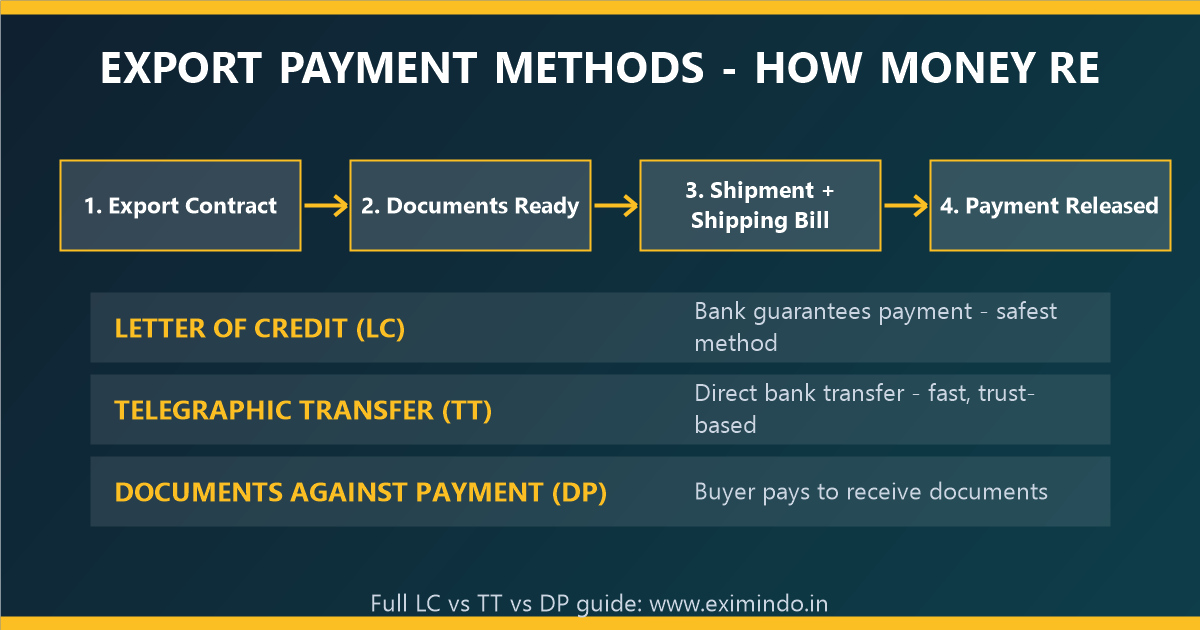
    The 4 Payment Methods Every Exporter Must Know

    Method How It Works Security for Seller Typical Use
    TT Advance (Telegraphic Transfer) Buyer wires money before shipment Highest — you get paid first New buyers, small orders, first-time deals
    LC (Letter of Credit) Buyer’s bank guarantees payment against documents High — bank-guaranteed Large orders, new but credible buyers, importers’ requirements
    DP (Documents against Payment) Buyer pays at sight to get shipping documents Medium — payment before documents released Established buyers, repeat orders
    DA (Documents against Acceptance) Buyer accepts a bill and pays later (30–90 days) Low — credit given to buyer Trusted long-term buyers only
    Open Account Ship first, invoice, buyer pays later Lowest — avoid unless insured Very trusted partners, credit-insured deals

    LC vs TT: The Direct Comparison

    Factor Letter of Credit (LC) Telegraphic Transfer (TT)
    Payment guarantee Buyer’s bank guarantees payment No bank guarantee — only buyer’s promise
    Risk to exporter Low (bank risk instead of buyer risk) Medium (depends on advance %)
    Cost High — LC opening + negotiation + discrepancy charges Low — just wire charges
    Time to payment 5–15 days after documents are presented 2–5 days after wiring
    Paperwork Heavy — documents must match LC terms exactly Minimal
    Best for Large orders, new buyers, high-value goods Small orders, repeat buyers, partial advance

    The short version: LC is safer but costlier and stricter; TT is faster and cheaper but only as safe as the advance percentage. Most exporters use 30–50% TT advance + balance by LC or DP — a blend that covers your cost and keeps the buyer honest.

    How a Letter of Credit Actually Works

    Export payment methods explained - LC, TT and DP flow | Eximindo

    1. You and the buyer agree on terms; buyer applies to their bank for an LC in your favour
    2. Your bank receives and advises the LC — check every field (amount, dates, documents, shipping terms)
    3. You ship the goods exactly as the LC says
    4. You present the documents (invoice, packing list, bill of lading, etc.) to your bank
    5. Your bank checks documents against the LC; if they match, the buyer’s bank pays

    One discrepancy in a document — a spelling difference, a late date — and the LC payment can be delayed by weeks. That is why LC-based exporters train seriously on documentation.

    When to Use Each Method

    • New buyer, first order: insist on 30–50% TT advance; balance on DP or LC
    • Large order (₹10 lakh+): LC — bank guarantees protect both sides
    • Repeat, trusted buyer: DP or 30% advance + balance on TT after shipment
    • Small orders (< ₹2 lakh): full TT advance — transaction costs make LC uneconomical
    • Only use DA / open account when you have history and preferably trade credit insurance

    Payment Risks to Protect Against

    • ⚠️ Buyer disappears after goods are shipped (no advance taken)
    • ⚠️ Fake purchase orders and “advance fee” scams targeting new exporters
    • ⚠️ LC discrepancies used as an excuse not to pay
    • ⚠️ Currency fluctuation eating your margin — consider quoting in USD with a buffer
    • ⚠️ Unverified buyers on buyer directories — verify via DGFT denied-entity lists and buyer background checks

    Learn Payment Terms & Negotiation Practically

    Payment terms are negotiated on every single order, and the skill is learned by practice. Our export import course covers LC drafting, TT advances, DP/DA, and real invoice negotiation in 69 practical lessons (Hindi + English, online + offline). It’s the same training that has built our export import training program in Indore and helped 1.5 lakh+ students. See why exporters call it the best export import course in India, and check realistic margins in our export business profit guide.

    Confused about which payment method a specific buyer is asking for? Ask us on WhatsApp (+91 89898 65646) — free consultation. Follow @eximindo on Instagram and Eximindo on LinkedIn for export trade tips.

  • Is Export Business Profitable in India? Real Profit Margins (2026)

    Is Export Business Profitable in India? Real Profit Margins (2026)

    “Is export business profitable?” is one of the most searched questions on the internet — and for good reason. The honest answer: yes, export business can be very profitable in India, but the margin depends entirely on what you export, how you source, and how you price. In this guide, we break down real export profit margins, the most profitable products, and the costs that quietly eat your profits.

    Typical Export Profit Margins

    Here are realistic margin ranges across different export models:

    Model Typical Margin Notes
    Export trading (buy & sell) 8% – 20% Margin on each shipment; fastest to start
    Manufacturer-exporter 15% – 30% Higher margin, needs production capacity
    Handicrafts & niche products 25% – 50% High value, low competition categories
    Agricultural / commodity exports 5% – 12% High volume, thin margin, price-volatile
    Services export (IT, consulting) 40% – 70% Highest margin, needs skills

    A well-run export business with 3–5 repeat buyers and steady shipments can comfortably earn ₹30,000 – ₹1,00,000+ per month within the first year — but only with proper pricing and product selection.

    What Makes Export Business Profitable in India

    • Low manufacturing cost — Indian products are cost-competitive globally
    • Export incentives — RoDTEP, RoSCTL, and duty drawback schemes add 2–5% to your bottom line
    • Scale — one container of a good product can equal months of domestic sales
    • Repeat orders — international buyers reorder for years once they trust you
    • Currency advantage — a weak rupee makes Indian exports cheaper and more competitive

    The Costs That Eat Your Margin

    Beginners quote prices using only the factory cost — and then lose money on every shipment. Always calculate your full cost:

    • Product cost (or manufacturing cost)
    • Packing & export packaging
    • Freight (sea or air)
    • Insurance
    • Customs duties & port charges
    • Bank charges on foreign remittances
    • Commission to agents/export houses

    Your selling price must cover all of these plus your target profit. Most profitable exporters work on a margin of 10–20% after all costs — which is far better than typical domestic trading margins.

    Most Profitable Products to Export from India

    • Basmati rice & spices (huge global demand)
    • Handicrafts, brass & wooden decor
    • Garments & textiles
    • Ayurvedic & herbal products
    • Auto parts & engineering components
    • Frozen & processed foods

    For a deeper list with 2026 trends, see export business ideas 2026.

    How Much Capital Do You Need?

    With export trading, you can start with ₹50,000 – ₹5,000 depending on your product. Buyers usually pay a 30–50% advance, which funds your purchase — so your actual working capital requirement is lower than you think.

    How to Protect Your Profit

    • ✅ Get an IEC code and GST registered before the first order
    • ✅ Use advance payment or Letter of Credit for new buyers
    • ✅ Verify buyers on government watch lists (DGFT denied entities)
    • ✅ Insure every shipment
    • ✅ Never ignore HS code classification — errors mean penalties, not just delays

    What Most Beginners Miss: The Right Method

    The difference between a profitable exporter and someone who quits after two losses is training. Product selection, buyer finding, pricing, documentation, and payment security — each is a skill you can learn in weeks, not years. Our export import course teaches all of it practically, in Hindi and English, with 69 lessons. Compare options in best export import course in India.

    Want to know if export business is profitable for your product? Message us on WhatsApp for a free consultation.

  • Export Business Ideas 2026: 15+ Profitable Products to Export from India

    Export Business Ideas 2026: 15+ Profitable Products to Export from India

    Last updated: August 2026 | By Anurag Jain, International Trade Specialist, Eximindo

    India is the world’s largest exporter of several agricultural products, a top supplier of generic pharmaceuticals, and a rising hub for engineering goods, spices, textiles and digital services. For a new exporter, the hardest question is not how to export — it is what to export. This guide lists the most profitable export business ideas for 2026, with realistic start-up budgets, target markets and documentation needs for each.

    Quick note: You do not need to be a manufacturer to start an export business. You can start as a trader and tie up with suppliers. That is exactly what we teach in our 100% practical Export Import Course — product selection, buyer finding and documentation, from ₹299.

    1. Spices (Turmeric, Chilli, Cumin, Coriander)

    India produces about 75% of the world’s spices. The global spice market is projected to keep growing through 2026 and beyond as demand for Indian flavours rises in the Middle East, USA, UK, and Southeast Asia. Start with value-added forms — ground, packaged, organic-certified — for better margins than bulk exports.

    • Start-up budget: ₹2–5 lakh (trading model)
    • Key markets: UAE, USA, UK, Vietnam, Sri Lanka
    • Certifications: FSSAI, Spices Board licence, organic (NPOP) if applicable

    2. Basmati Rice and Non-Basmati Rice

    India is the world’s leading rice exporter. Basmati commands a premium in the Gulf and Western markets; non-basmati (IR64, sona masoori) goes in bulk to Africa and Southeast Asia. Both are strong, steady categories.

    • Start-up budget: ₹5–10 lakh
    • Key markets: Saudi Arabia, Iran, UAE, Iraq, Benin
    • Documentation: APEDA registration, phytosanitary certificate, mill test certificate

    3. Ready-Made Garments and Textiles

    Apparel and home textiles remain one of India’s largest export categories. Fast-fashion supply chains are diversifying away from single sourcing, and Indian manufacturers are gaining orders from Europe and North America.

    • Start-up budget: ₹3–8 lakh
    • Key markets: USA, UK, Germany, France
    • Compliance: Buyer audits (BSCI/SEDEX), lab testing per buyer requirement

    4. Pharmaceuticals and Nutraceuticals

    India is the “pharmacy of the world”, supplying affordable generic medicines to over 150 countries. Nutraceuticals (herbal supplements, Ayurveda-based products) are a fast-growing adjacent category where smaller exporters can still enter.

    • Start-up budget: ₹5–15 lakh (requires more compliance)
    • Key markets: Africa, Southeast Asia, USA, Europe
    • Licences: WHO-GMP, CDSCO export registration, country-specific registrations

    5. Processed and Packaged Foods

    Pickles, papad, snacks, instant mixes, fruit pulps and bakery goods travel well when properly packaged and certified. The Indian diaspora and growing global interest in Indian food make this an accessible category for first-time exporters.

    • Start-up budget: ₹2–6 lakh
    • Key markets: USA, UK, Canada, Australia, Gulf
    • Compliance: FSSAI export licence, shelf-life study, ingredient labelling per destination

    6. Handicrafts and Home Decor

    From brassware and wooden furniture to marble inlay and dhokra art, Indian handicrafts have loyal buyers worldwide. E-commerce marketplaces have lowered the entry barrier for this category dramatically.

    • Start-up budget: ₹1–4 lakh
    • Key markets: USA, UK, Germany, Japan
    • Tips: Use high-quality photography and clear product specifications; EPCH registration helps for exhibitions

    7. Engineering Goods and Auto Components

    India’s engineering exports have grown steadily. Hand tools, fasteners, pumps, bearings and two-wheeler spares have consistent demand in Africa, the Middle East, Latin America and South Asia.

    • Start-up budget: ₹5–15 lakh
    • Key markets: UAE, USA, UK, Nigeria, Bangladesh
    • Documentation: BIS standards compliance, buyer-specified quality certifications

    8. Fresh Fruits and Vegetables

    Mangoes, bananas, pomegranates, onions and grapes are exported profitably, but fresh produce needs cold-chain handling. If logistics scare you, start with frozen or dehydrated fruits and vegetables instead.

    • Start-up budget: ₹3–10 lakh (fresh) / ₹2–6 lakh (frozen/dehydrated)
    • Key markets: UAE, Bangladesh, Malaysia, Europe (mango season)
    • Compliance: APEDA registration, phytosanitary certificate, pest treatment

    9. Leather and Footwear

    India is among the top five producers of leather footwear and goods. The segment is shifting toward value-added finished products, and government PLI schemes support it.

    • Start-up budget: ₹5–10 lakh
    • Key markets: USA, UK, Germany, Italy
    • Compliance: Buyer-specific testing for azo dyes, chromium content

    10. IT Services and Digital Products

    Software services, content services, website development and BPO work are technically “exports” under foreign exchange rules. These need almost no capital and are the easiest to start from a laptop.

    • Start-up budget: ₹50,000–2 lakh
    • Key markets: USA, UK, Australia, Middle East
    • Payment: Invoicing in foreign currency via authorised dealer bank; ensure LUT (Letter of Undertaking) for GST exemption if applicable

    11. Ayurveda and Herbal Products

    Global wellness trends continue to push demand for Ayurvedic oils, cosmetics, teas and supplements. Brands like Dabur and Patanjali have mainstreamed the category; small exporters can serve niche buyers in the USA, EU and Gulf.

    • Start-up budget: ₹2–8 lakh
    • Key markets: USA, Germany, UAE, UK
    • Compliance: GMP certification, country-specific cosmetics/health registration

    12. Toys and Sports Goods

    India’s toy industry is expanding with government incentives (“Toycathon” and production-linked incentives). Sports goods from Meerut and Jalandhar already export widely.

    • Start-up budget: ₹2–7 lakh
    • Key markets: USA, UK, Germany, UAE
    • Compliance: EN71 (EU) or ASTM (USA) toy safety standards

    13. Marine Products (Shrimp, Fish)

    India is a leading exporter of frozen shrimp. This is a high-value, high-compliance category best entered through established processing units or in partnership with exporters.

    • Start-up budget: ₹10–25 lakh (processing-linked)
    • Key markets: USA, China, Japan, EU
    • Compliance: MPEDA registration, export inspection certificates, traceability

    14. Chemicals and Dyes

    Inorganic chemicals, pigments and dyes have steady industrial demand. This is a B2B-heavy category — longer sales cycles but strong repeat orders.

    • Start-up budget: ₹5–20 lakh
    • Key markets: China (re-export hubs), Middle East, Africa, Europe
    • Compliance: MSDS documentation, transport regulations (ADR/IMDG)

    15. Renewable Energy Components

    Solar panels, inverters, LED lighting and EV components are among the fastest-growing export categories, driven by global energy transition spending.

    • Start-up budget: ₹5–20 lakh
    • Key markets: USA, Europe, Middle East, Africa
    • Compliance: BIS/IEC certifications, country-specific electrical certifications

    How to pick the right product for you

    1. Check demand, not just trends: use export-import data (DGFT, trademap.org, UN Comtrade) to see real shipment volumes.
    2. Match your location: export what your region already produces — cheaper sourcing beats exotic ideas.
    3. Start with value addition: packaging, grading and branding lift margins far more than raw bulk.
    4. Verify compliance early: confirm certifications before you invest in inventory.
    5. Test with small orders: one container or even air freight sample orders de-risk everything.

    What you need to start legally (checklist)

    • PAN card and current account in your business name
    • IEC (Import Export Code) from DGFT — free of cost
    • GST registration and LUT for export exemption
    • AD Code (Authorised Dealer Code) from your bank
    • APEDA / Spices Board / MPEDA / EPCH registration depending on product
    • RCMC (Registration-cum-Membership Certificate) with the relevant export promotion council

    Frequently asked questions

    Which product is best to export from India in 2026?

    Spices, rice, garments, engineering goods and IT services are the most accessible for new exporters. The best product for you depends on your location, capital and existing supplier network — match demand data with what your region can supply.

    How much money do I need to start an export business?

    You can start a trading-based export business with ₹1–5 lakh depending on the product. Digital services exports need even less. Avoid locking capital in inventory before you have a confirmed buyer or letter of credit.

    Can I export without being a manufacturer?

    Yes. Most first-time exporters work as merchant exporters — they buy from manufacturers and sell abroad. This is a legal, common and low-risk way to begin.

    How do I find international buyers?

    B2B marketplaces (IndiaMART, Alibaba), trade fairs, buyer databases, and cold outreach through email/LinkedIn are the standard routes. We explain the full process in our guide on how to find international buyers.

    Do I need an export licence?

    For most products you need an IEC code (free, online) plus product-specific registrations like APEDA or Spices Board. Restricted items (like some agri-products and minerals) need specific licences — always check the DGFT ITC-HS schedule first.

    Ready to start your export business?

    Our Export Import Course covers product selection, buyer finding, documentation and payment security in 69 practical lessons — online and offline, from just ₹299. Get guidance from exporters with 12+ years of experience and join 1,50,000+ learners across 30+ countries.

    📞 Call/WhatsApp: +91 8989865646 | 📧 Info@eximindo.in

  • How to Find International Buyers for Export Business (Proven Methods)

    How to Find International Buyers for Export Business (Proven Methods)

    Finding international buyers is the single most important skill in export business. You can have the best product in India, but without buyers you have no business. The good news: there are proven, repeatable methods to find buyers abroad — and you can start today with just a phone and an internet connection.

    Eximindo has trained 1.5 lakh+ students in 30+ countries in practical buyer-finding strategies. This guide shares the exact methods used in our Finding Buyers module.

    Method 1: B2B marketplaces (fastest for beginners)

    B2B platforms connect Indian sellers with international buyers directly. The biggest ones:

    • IndiaMART — huge domestic and international buyer base
    • Alibaba — the world’s largest B2B marketplace
    • TradeIndia — popular with Indian exporters
    • ExportersIndia and Go4WorldBusiness — niche export portals

    How to use them: create a complete company profile, upload real product photos with clear prices, and respond to buyer inquiries within hours. Buyers compare dozens of suppliers — your profile quality decides whether they contact you.

    Method 2: Direct outreach to importers (email + LinkedIn)

    Direct outreach works when you target the right person. Importers, distributors and wholesalers in your product category are your ideal buyers.

    • Build a list of importers using import-export data, LinkedIn and trade directories
    • Send a short, specific email: who you are, your product, your price, your minimum order quantity
    • Follow up after 3–4 days — most deals close on follow-up
    • Send samples to serious buyers

    Tools like import records (e.g., customs data platforms) show you exactly who is already importing your product category — these are warm leads.

    Method 3: Trade fairs and exhibitions

    Nothing builds trust like meeting a buyer face to face. Major exhibitions for Indian exporters:

    • India International Trade Fair (IITF), New Delhi
    • Hannover Messe (Germany) and Canton Fair (China)
    • Country-specific trade shows for your product category

    At a trade fair, collect business cards, follow up within a week, and send your catalogue plus a sample. Exhibition leads close at a much higher rate than online leads.

    Method 4: Government trade bodies and export promotion councils

    Indian government bodies help you find buyers for free:

    • APEDA — agricultural and processed food products
    • EPCH — handicrafts
    • FIEO — Federation of Indian Export Organisations
    • Indian missions abroad — commercial wings of embassies share buyer leads

    These bodies organise buyer-seller meets and trade delegations where you meet verified buyers — often free or heavily subsidised.

    Method 5: Market research (find the right country first)

    Do not sell the same product everywhere. Research which countries have the highest demand for your product:

    • Check import statistics by country for your product code (HS code)
    • Study competitors — where are they selling?
    • Check cultural fit, packaging and certification requirements
    • Price your product with freight, duties and payment costs included

    In our export import course, the Global Opportunity module covers how to access 200+ country markets and pick the right one for your product.

    How to qualify a buyer (avoid scams)

    Not every inquiry is a real buyer. Qualify leads before spending money:

    • Ask for their company registration and import licence
    • Verify their website and business history
    • Prefer secure payment terms: advance payment or Letter of Credit
    • Never pay “registration fees” or “commission advances” to unknown buyers

    The Payments & Payment Security module teaches you to protect your margins on every order.

    How long does it take to find the first buyer?

    With consistent daily effort — 2–3 hours of profiles, outreach and follow-ups — most beginners receive their first serious inquiry within 4–8 weeks. The first order takes longer than the second: repeat buyers and referrals speed everything up.

    Learn buyer-finding the practical way

    Eximindo’s Export Import Course (₹299, 69 lessons) includes the complete Finding Buyers module with proven strategies, buyer outreach templates and real examples — in Hindi and English, online and offline.

    Frequently Asked Questions

    Which is the best platform to find international buyers?

    IndiaMART and Alibaba are the best starting points for beginners because they are free to join and have large buyer bases. Pair them with direct outreach for faster results.

    Can I find buyers without any budget?

    Yes. Free options include IndiaMART profiles, government buyer-seller meets, embassy trade wings, and direct email outreach using free import-export data samples.

    How do I know if a buyer is genuine?

    Ask for company registration documents, verify their website and trading history, and always use secure payment terms like advance payment or Letter of Credit.

    Do trade fairs really work for finding buyers?

    Yes — face-to-face meetings build trust fast. Follow up within a week with your catalogue and samples, and exhibition leads convert at a much higher rate than online leads.

    How do I contact international buyers directly?

    Use import-export trade data to find companies importing your product category, then send short, specific emails with your product, price and minimum order quantity. Follow up after 3–4 days.

    Start finding buyers today

    Message Eximindo on WhatsApp at +91 8989865646 for a free consultation, or enrol in the Export Import Course to learn buyer-finding step by step with mentors who have done it in real trade.

  • How to Start Export Business in India: Step-by-Step Guide (2026)

    How to Start Export Business in India: Step-by-Step Guide (2026)

    Yes, you can start an export business in India even if you have no product, no factory, and no experience. You only need three things: a registered business, an Import Export Code (IEC) from DGFT, and the right method to find buyers and ship your product. This guide explains exactly how to do it, step by step.

    Eximindo has trained 1.5 lakh+ students across 30+ countries in practical export-import business setup — the same method you will learn below.

    What is an export business in India?

    An export business sells Indian products to buyers in other countries. You do not need to manufacture anything. You find a product, find a buyer abroad, handle the paperwork, and get paid in foreign currency. Thousands of Indian traders do this every day without owning a factory.

    Step 1: Get your business registered

    Start by registering your business. The simplest options are:

    • Sole proprietorship — easiest, no registration required for most cases
    • One Person Company (OPC) or LLP — better for scaling and bank accounts
    • MSME/Udyam registration — free, gives you government scheme benefits
    • GST registration — required once you cross the threshold or for export documentation

    Step 2: Apply for IEC code from DGFT (free)

    The Import Export Code (IEC) is the most important number for your export business. It is issued by the Directorate General of Foreign Trade (DGFT) and is completely free since 2017. You need it to:

    • Ship goods out of India
    • Receive export payments in foreign currency
    • Claim export incentives and duty benefits

    Apply online at the DGFT portal with your PAN, bank account details and Aadhaar. Approval usually takes 3–7 working days. This is a one-time registration — there is no annual renewal fee.

    Step 3: Choose a product that actually sells

    Do not pick a product randomly. The best export products for beginners are ones with:

    • High demand in the target country
    • Simple documentation
    • Manageable shipping costs
    • Good margins after freight and duties

    Popular Indian export categories include handicrafts, textiles, spices, ayurvedic products, readymade garments, processed foods, and engineering goods. In our export import course, Module 1 (Quick Start Products) teaches you how to build a profitable product list even if you are not a manufacturer — you can export any product by sourcing it from suppliers.

    Step 4: Find international buyers

    Finding buyers is the skill that separates successful exporters from the rest. Proven methods include:

    • B2B platforms like IndiaMART, Alibaba and TradeIndia
    • Direct outreach to importers via email and LinkedIn
    • Trade fairs and exhibitions
    • Government trade bodies and export promotion councils
    • Buyer lists and market research reports

    Eximindo’s Finding Buyers module teaches proven strategies to reach buyers in 200+ country markets — the same strategies our mentors use in real trade.

    Step 5: Handle documentation correctly

    Export documentation looks scary, but it is a repeatable process. The core documents are:

    • Commercial Invoice and Packing List
    • Bill of Lading / Airway Bill
    • Shipping Bill (customs)
    • Certificate of Origin
    • Bank documents like LC and Bill of Exchange

    One wrong document can delay your shipment by weeks or cost you your payment. That is why our documentation module walks through every document with real examples.

    Step 6: Get paid safely in foreign currency

    Beginners lose money by accepting unsecured payment terms. Learn the payment ladder:

    • Advance payment — safest for new exporters
    • Letter of Credit (LC) — bank-guaranteed payment
    • Documents Against Payment (DP) — moderate risk
    • Open account — only for trusted repeat buyers

    You also need a bank account with export facilities (current account) and a bank certificate like the FIRC/AD code to prove your export earnings.

    Step 7: Claim government incentives

    India offers several export incentives that reduce your cost and increase profit:

    • RoDTEP (Remission of Duties and Taxes on Exported Products)
    • Interest equalisation scheme
    • State export promotion schemes
    • Duty drawback on customs

    Most new exporters leave money on the table because they do not know which incentives apply to their product. Our Government Incentives module covers this in plain language.

    How long does it take to start exporting?

    With the right guidance, you can complete registration, IEC, product selection and buyer outreach within 30–60 days. Your first order can follow in the next few weeks depending on your product and market.

    Do you need an export training course?

    You can learn by trial and error — but mistakes in documentation, payment terms and buyer selection can be expensive. A structured course shortens your learning curve from years to weeks. Eximindo’s Export Import Course (₹299 online masterclass, 69 lessons) covers product selection, buyer finding, documentation, payments, incentives and global opportunity — in Hindi and English, online and offline.

    Frequently Asked Questions

    Can I start an export business without any money?

    You can start with a very small amount. The IEC is free, MSME registration is free, and you can source products only after receiving an advance or LC from your buyer. Many exporters start with under ₹50,000.

    Is export business profitable in India?

    Yes. Export margins are often 15–40% on products, and government incentives add to your profit. The key is choosing the right product and buyer — that is exactly what we teach in the course.

    Do I need to speak English for export business?

    No. Exporters work in Hindi, English and many regional languages. Basic English for emails and invoices is helpful, and the paperwork templates are standardised.

    What is the first step to start an export business?

    The first step is getting your Import Export Code (IEC) from DGFT, which is free. Do this in parallel with registering your business and studying your product.

    Can a student or housewife start an export business?

    Yes. Eximindo’s motto is ABCDE — Anybody Can Do Export. Our students include students, professionals, traders and homemakers who started exporting without a factory or prior experience.

    Start today

    You do not need to figure this out alone. Message Eximindo on WhatsApp at +91 8989865646 for a free consultation, or enrol in the Export Import Course — 69 lessons, ₹299, lifetime access, Hindi and English.